
3DLogistiX: a 3D warehouse management system for SMB operators
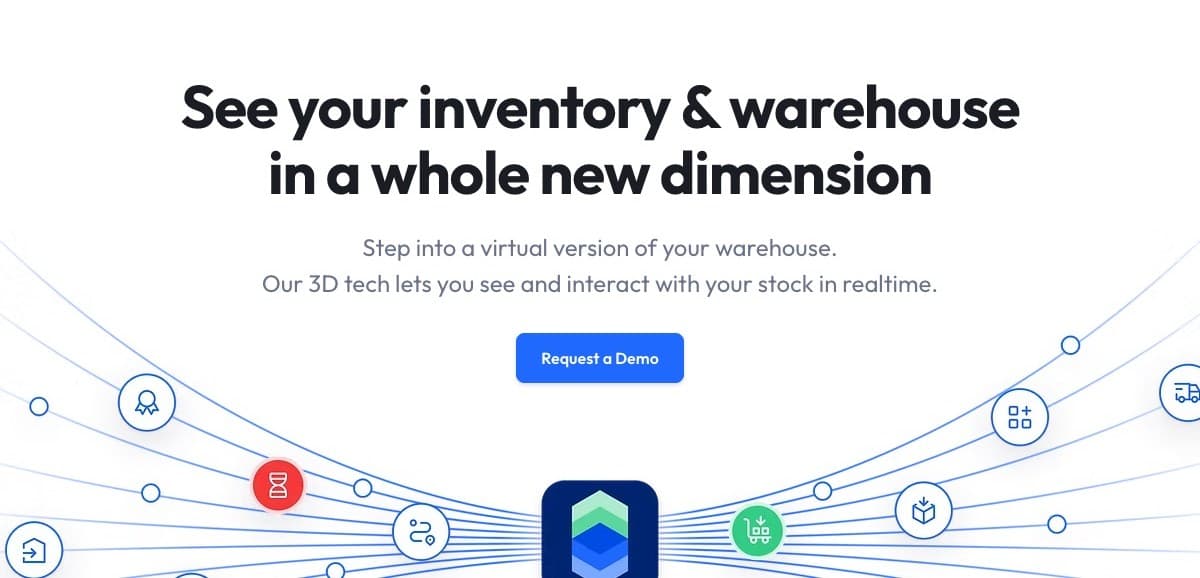
3DLogistiX Pty Ltd sells a cloud warehouse management system to small and mid-sized manufacturers, wholesalers, retailers, and 3PLs running one or several warehouses. The company lists offices in Melbourne, Sydney, Brisbane, and Montreal and positions the product as Australia’s leading 3D WMS for SMBs. Its selling point is the visual layer: a digital twin of the facility that managers can move through, paired with guided picking, an order hub for multi-channel orders, smart replenishment, and integrations with the accounting, ecommerce, and shipping tools an ANZ operator already uses. Explore the product on the 3DLogistiX website.
Sigi’s part in this was engineering capacity rather than a turnkey build. Our engineers were embedded in the 3DLogistiX product team on a staff-augmentation basis and contributed to the core warehouse modules, the Flutter handset app, and the administrative dashboards; the architecture and implementation notes below are written from that first-hand work. The same model sits behind our IT staffing service, and the domain is core to our logistics industry practice.
The problem: accurate inventory, live floor execution, and a warehouse you can see
A WMS earns its keep in the details, and the details are where spreadsheet-era tooling breaks. Four pain points shaped the build.
- Location-level accuracy across facilities: stock has to be tracked to the exact rack and bin in every building, and one mis-recorded put-away skews counts, picks, and replenishment downstream.
- Floor execution lag: paper pick lists and end-of-shift data entry mean the dashboard describes the warehouse as it was hours ago, not as it is.
- Legibility: a manager reading rows of location codes cannot tell which zones are nearly full, where pickers are bunching up, or which aisle a delayed order is stuck in.
- Tenancy: every customer needs isolated data, its own roles, and its own facility layouts on shared infrastructure, without a bespoke deployment for each one.
The stack we built it on
The platform is split into three surfaces over one backend. Managers use a React and Next.js web application with the interactive 2D and 3D warehouse views rendered in Three.js on WebGL. Floor staff use a Flutter app on iOS and Android. Tenant administrators use dashboards for provisioning, roles, and reporting. Underneath sit Node.js microservices with MongoDB as the primary store, Redis for hot state and pub/sub, and WebSockets pushing changes out to browsers and handsets. The whole stack runs on AWS and is provisioned with CDK, which is the same infrastructure-as-code approach we apply across our DevOps and cloud engagements.
Key design decisions and why
- Services split by warehouse domain rather than by screen. Inventory, inbound and outbound orders, tasks, facility layout, and tenancy/auth each own their data, so a change to picking logic does not ripple into the visualization service. SQS and SNS carry the events between them: a scan on a handset becomes a stock-movement event that dashboards, the 3D view, and replenishment all consume independently.
- Document storage for document-shaped data. Facility layouts, rack hierarchies, and per-tenant configuration are nested structures that change shape between customers; MongoDB stores them as they are, while Redis holds the frequently read current-quantity and task-state data the live views poll constantly.
- Serverless at the edges, long-running at the core. API Gateway and Lambda absorb spiky integration and webhook traffic; S3 and CloudFront serve the web bundle and facility model assets; Amplify hosts the front end. WebSocket fan-out stays on persistent services where connection state belongs.
How the platform is built and run
3DLogistiX is engineered and operated the way enterprise SaaS has to be — resilient, secure, and cost-aware:
- Services split by warehouse domain, with SQS and SNS carrying stock-movement events between inventory, orders, tasks, visualization, and replenishment.
- Multi-tenant isolation — every document, cache key, queue message, and socket channel is scoped to a tenant, with role-based access on top of that boundary.
- Infrastructure as code in CDK — environments stay reproducible and infrastructure changes are reviewed like any other pull request.
- Serverless at the edges — API Gateway and Lambda for spiky integration traffic; Amplify, S3, and CloudFront for the web bundle and facility model assets — with persistent services for WebSocket fan-out.
- Automated CI/CD — GitHub Actions builds and Playwright end-to-end tests on every merge.
What we implemented: web, 3D view, mobile, and admin surfaces
Sigi’s engineers worked across all four surfaces of the platform. Here is what it implements across the web app, the 2D/3D view, the Flutter handset app and admin.
Web platform for managers and supervisors
- Multi-facility inventory with quantities tracked to the rack and bin, searchable by SKU, location, or order.
- Inbound workflow: receiving against expected deliveries, put-away task generation, and exception handling for short or damaged deliveries.
- Outbound workflow: order release, pick task creation, packing confirmation, and dispatch, with the order hub consolidating ecommerce, B2B, and wholesale channels.
- Task assignment and tracking: supervisors assign picks, put-aways, and counts to named workers and watch progress in real time.
- Operational dashboards for stock levels, movement history, task throughput, and per-facility metrics.
Interactive 2D and 3D warehouse visualization
- 2D plan view of each facility showing zones, aisles, and rack occupancy at a glance.
- 3D walk-through of the same layout, with bins colored by fill level and clickable to reveal their contents.
- Live movement overlay: stock changes and task completions from the floor appear in the scene as they happen.
- Layout editing so a tenant’s own racking, mezzanines, and staging areas are modeled rather than approximated.
3DLogistiX Mobile: the Flutter app for the warehouse floor
The handset app is published as 3DLogistiX Mobile on Google Play and on the App Store, both under the 3DLogistiX Pty Ltd developer account; the iOS listing has been live since May 2025. The store descriptions match the goals the build targeted: replacing paperwork with digital workflows, improving picking and put-away accuracy through guided steps and real-time capture, and giving staff instant visibility into inventory. A single Flutter codebase covers both platforms, an approach we detail in our mobile app development service.
- Barcode scanning for receiving, put-away, picking, packing, and cycle counts — using the device camera or an integrated hardware/handheld scanner on the warehouse floor.
- Guided task lists per worker, ordered by the platform, with confirmation scans at each location.
- Instant inventory updates: a scan writes through to the backend and appears on manager dashboards and the 3D view within the same session.
- Role-aware screens so a picker, a packer, and a supervisor each open to the work relevant to them.
Admin panel and tenant management
- Tenant provisioning with per-customer facilities, users, and roles.
- Role-based access control across web and mobile from one permission model.
- Reporting dashboards that connect store, warehouse, and shipping data for each tenant.
Around those surfaces, the platform integrates with the systems an operator already runs, through a documented, API-first integration layer so a new channel or carrier is an adapter rather than a rewrite: Shopify, WooCommerce, Magento, Amazon, and eBay for orders; Xero, MYOB, QuickBooks, and NetSuite for accounting; Starshipit, ShipStation, Shippit, MachShip, and SmartFreight for carriers; Stripe for subscription billing; and hardware barcode and handheld scanners for the floor. The Shopify connector shipped as a dedicated app on the Shopify App Store in July 2025.
Delivery and engineering practice
Working inside another company’s product team means matching their cadence rather than imposing one. Web flows such as receiving, pick-and-pack, and layout editing are covered by Playwright end-to-end tests, and GitHub Actions runs the test suites and deployments on every merge. Infrastructure changes go through CDK so environments stay reproducible, and the WebSocket synchronization between handsets and browsers is exercised as part of the automated suite rather than checked by hand.
The team and expertise behind the build
Sigi contributed to 3DLogistiX as an embedded engineering team — full-stack, mobile and QA specialists working inside the client’s product team as one unit rather than a hands-off outsourcer. Sigi hires only specialists: every engineer is an expert in their own field, and we invest in the team as they deliver, supporting certifications and continuous learning so expert, motivated engineers stay on every build. It is the model we have run since 2016: deep, cross-industry expertise across the whole stack, from the React and Three.js web app and the Flutter handset app to the Node.js microservices and the AWS infrastructure behind them. Real-time 3D visualization, multi-tenant isolation and live floor sync are exactly the kind of demanding, full-stack engineering our team is built for — the same capability behind our IT staffing and mobile app development work.
What shipped: where 3DLogistiX stands today
The outcome is a commercial SaaS warehouse management system that operators can trial and subscribe to without a consulting engagement. 3DLogistiX sells on three published tiers (Starter, Growth, and Scale, listed from US$350 a month on the Shopify App Store), offers a 14-day free trial from its website, takes subscriptions through Stripe on three published tiers, has 3DLogistiX Mobile live on both app stores, and integrates with ecommerce, accounting, shipping, and payment platforms alongside hardware barcode scanners.
See the product on the 3DLogistiX website, install 3DLogistiX Mobile from the App Store or Google Play, or review the Shopify integration listing.
Related logistics and SaaS engineering
Founders asking how to scope a WMS can start with the guide How to build a warehouse management system, which uses this 3DLogistiX engagement as the named proof.
Warehouse software is one end of the logistics chain we build for. The Pacifrica Express platform covers freight and shipment tracking, Shipping Hack handles parcel forwarding, and Antrak and Bix Delivery are on-demand courier products with customer apps, driver apps, and Node.js dispatch backends. Two builds outside logistics share this project’s data problems: the Bilawal Electronics ERP tracks multi-branch stock and installment plans on Laravel, and the Government of Jamaica school meal system turns a QR scan at the serving point into live enrollment and budget data, much as a handset scan here becomes a stock movement. For platform builds of this shape, start with our custom software development service.
Planning a warehouse management system, a multi-tenant SaaS product, or a 3D visualization layer of your own? Talk to Sigi about the architecture and the team it would take.