A Lahore fashion label selling lawn and pret online
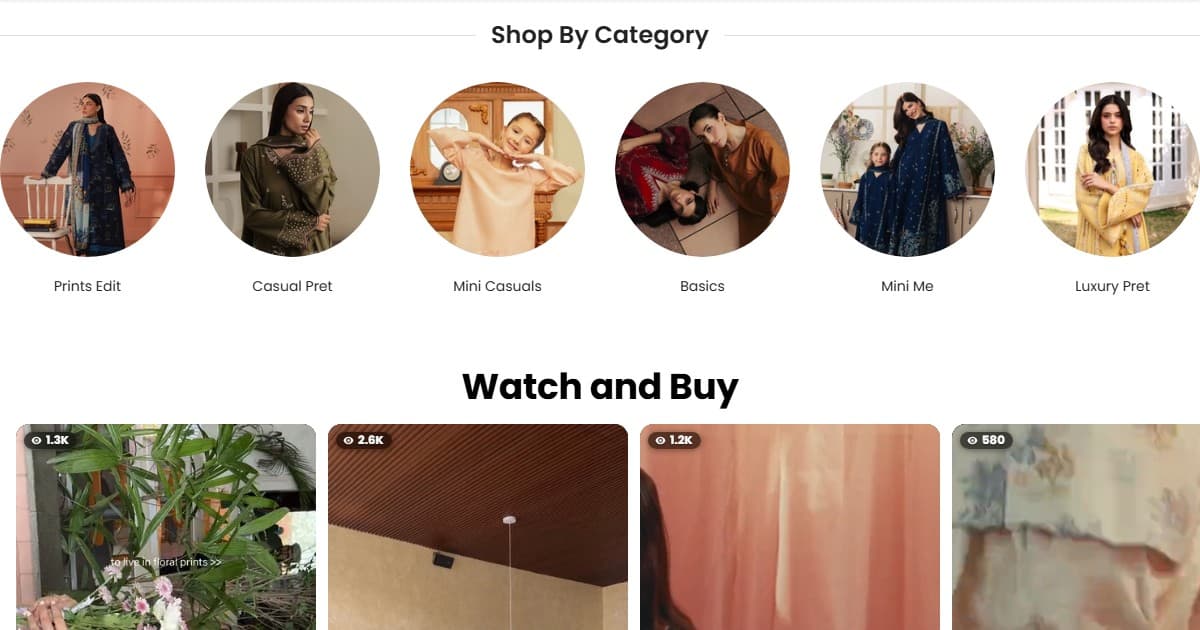
ZIVA designs and sells women’s clothing from Lahore, and ships international orders through a US entity in Houston. The catalog splits into two very different products: unstitched three-piece sets in cotton lawn, cambric, organza and silk, which the customer has tailored locally, and ready-to-wear pieces sold in XS–XL. Collections such as Prints Edit, Casual Pret, Luxury Pret, Basics, Tops and Mini Me rotate through the year. At the time of writing (September 2026) a Season End Sale occupies the homepage banner and the last slot in the main menu, with discounts of up to 50% across much of the range.
That mix is normal for a Pakistani clothing brand and unusual for a stock Shopify theme. Unstitched fabric has no size variant but does need fabric and piece-count details up front; pret needs a size selector and a clear exchange path; kids’ pieces are sold by age range. Add a domestic audience that expects cash on delivery and a diaspora audience paying by card, and the store has to present one brand while quietly running two commerce models.
What a fashion storefront had to get right
Before any theme work, three constraints shaped the build.
- Presentation on mobile. Lawn sells on print detail and embroidery close-ups, so product imagery is heavy by nature, and most traffic arrives from Instagram and Facebook on a phone. A page that looks rich on a desktop preview and stalls on 4G loses the sale.
- Two fulfillment models in one catalog. In-stock items dispatch in 1–2 working days; pre-orders dispatch in 12–22 working days. Shoppers needed to see which they were buying before checkout, not in a confirmation email.
- Local and international checkout. Pakistan orders needed COD, a flat Rs. 200 delivery fee with free delivery over Rs. 4,000, and bank transfer or IBFT options. International orders needed card, Shop Pay and Apple Pay, a flat $30 shipping promise, and a 10–15 working day delivery estimate that customs delays would not undermine.
The stack we built it on
Shopify was the right base for a label whose team runs merchandising, campaigns and customer care without in-house developers. Products, variants, discounts and shipping zones live in the Shopify admin; the engineering effort went into the theme layer and the catalog model rather than into a custom backend, which is the usual shape of our e-commerce development work.
The storefront runs on the Kalles theme, customized in Liquid. Kalles ships with a large section library and a product-grid system that suits fashion, which cut the design-to-theme time compared with building from Dawn. The trade-off is weight: a multi-purpose theme loads CSS and JavaScript for features a single-brand store never uses, and taming that became the main performance task (covered below).
Catalog modeling followed how ZIVA actually merchandises. Each seasonal drop is a collection (Noirae, Zarah, Mini Me Vol. II), and product handles carry fabric and construction in the name, such as Aster 3-piece silk RTW or Botanica unstitched lawn, so search and sort stay meaningful as the range grows. Ready-to-wear products carry size variants; unstitched products carry none and instead surface piece count and fabric in the description block.
How the platform is built and run
ZIVA runs on Shopify, so the engineering went into the theme layer and the catalog model rather than a custom backend:
- Products, variants, discounts and shipping zones live in the Shopify admin, so ZIVA’s team runs merchandising, sales and campaigns without a developer.
- The storefront is the Kalles theme customized in Liquid, with the customizer schema kept editable per section so the team can rearrange homepage blocks for a new drop.
- A catalog modeled on how the brand merchandises: each seasonal drop is a collection, ready-to-wear carries size variants, and unstitched sets carry none and surface fabric and piece count instead.
- Shopify’s hosted, PCI-compliant checkout carrying two commerce models — Shop Pay, Apple Pay and cards for international orders, and cash on delivery, bank deposit and IBFT for Pakistan — with shipping fees and thresholds encoded in the admin.
- Performance work for an image-heavy store: images served through Shopify’s CDN with srcset and width parameters, native lazy loading on product and collection media, unused Kalles sections and their CSS/JS removed from the bundle, and third-party scripts deferred.
- Design done first in Figma at mobile width using real product photography, then built section by section in Liquid, with Judge.me reviews, a wishlist, and Meta, TikTok and Google tags installed for reviews and campaign reporting.
What we implemented: the storefront
Sigi built and customized every part of the storefront. Here is what we implemented across the homepage, the theme, checkout and campaigns.
Homepage and collection navigation
The header menu is deliberately short: Home, New In, Women, Girls, Season End Sale. A promotional bar above it carries the two messages that answer the most common customer-care questions, dispatch timing and international shipping cost. Collection pages use the theme’s grid with Quick Shop, Add to Cart, sale badges showing the original and discounted price, and a Load More pattern rather than pagination, which keeps scroll momentum on mobile. Sorting covers featured, best selling, price and date.
Theme and UX customizations in Liquid
- Product cards that show fabric type and piece count for unstitched sets and a size selector for ready-to-wear, so the two product types read differently at a glance
- Compare-at pricing and percentage-off badges wired to Shopify’s native discount fields, so the team runs sales from the admin without touching the theme
- Wishlist on product cards and product pages, with counts in the header
- Judge.me product reviews embedded on product pages
- A dispatch-timing block on every product page that states 1–2 working days for in-stock items and 12–22 working days for pre-orders
- Shoppable video reels on the homepage, drawing on the same short-form content the brand posts on Instagram and TikTok
- Footer with policy links (Exchange, Refund, Order Cancellation, Privacy, Terms, FAQs) and the Lahore and Houston addresses, which matter for international trust
- Payment-method icons (Visa, Mastercard, American Express, PayPal, Maestro, Discover) surfaced in the footer and on policy pages
Checkout and payments
Checkout runs on Shopify’s hosted, PCI-compliant flow, with Shop Pay and Apple Pay for returning and mobile shoppers and card payments for international orders. Pakistani customers can choose cash on delivery, direct bank deposit or IBFT. Shipping rules encode the domestic fee and free-delivery threshold, and the exchange policy, seven days from delivery, Pakistan only, one exchange per order, is linked from the footer so it is visible before purchase rather than discovered afterwards. Order tracking numbers go out by email and WhatsApp once the courier scans the parcel.
Campaigns and promotions
Seasonal sales are the rhythm of a lawn brand. The sale collection, discount badges and promotional bar are all driven from admin settings, and Meta Pixel, TikTok Pixel and Google tags are installed so paid campaigns report conversions back to the platforms where ZIVA buys traffic.
Performance optimization for an image-heavy Shopify theme
Fashion stores are image stores. At the time of writing the ZIVA homepage renders more than a hundred lazy-loaded images, and every product ships with several high-resolution shots, so the performance work concentrated on how those images are delivered and on the weight of the theme around them.
The techniques above are what shipped; the live store is the place to see how they hold up.
Delivery: Figma to Liquid
Design came first. Homepage, collection, product, cart and policy templates were laid out in Figma at mobile width before desktop, using real product photography from the brand rather than placeholders, so the type scale and image ratios were decided against actual embroidery detail. It is the same sequence our UI/UX design team follows on app work. Theme work then proceeded section by section in Liquid, with the customizer schema for each section kept editable so the ZIVA team can rearrange homepage blocks for a new drop without a developer.
The team and expertise behind the build
ZIVA’s store was delivered by one cross-functional Sigi team — UI/UX designers and front-end engineers working as a single unit rather than handing the build between vendors. Sigi hires only specialists: every designer and engineer is an expert in their own field, and we invest in the team as they deliver, supporting certifications and continuous learning so expert, motivated people stay on every build. It is the model we have run since 2016: deep, cross-industry expertise, here applied end to end from the Figma design and the Liquid theme customization to the two-model catalog, the cash-on-delivery-and-card checkout and the image-delivery performance work. Making one storefront present unstitched fabric and ready-to-wear cleanly while staying fast on a phone is exactly the kind of detail-led commerce work our team is built for — the same capability behind our UI/UX design and web application development work.
What shipped: the live store
ZIVA’s store is live at shopatziva.com, trading in PKR with international checkout, cash on delivery in Pakistan, dispatch timing shown before purchase, and a catalog of around 195 products spanning unstitched lawn, ready-to-wear and girls’ wear. Prices at the time of writing run from Rs. 2,680 for a stole to Rs. 29,880 for a three-piece silk ready-to-wear set. The brand runs sales, new-in drops and campaign landing sections from the Shopify admin.
Related e-commerce work
ZIVA sits alongside other retail builds in our portfolio. The Kwik eMart grocery delivery platform is the opposite shape of project: a custom Next.js and React Native storefront with retailer, driver and admin surfaces for 15-minute grocery delivery in Scotland, where a hosted platform would not have fit. The Busy Bean coffee subscription site is closer to ZIVA, a single-brand store where the theme and checkout carry the product. For a store of your own, see our E-commerce industry practice and Web Application Development service, or contact Sigi to talk through a Shopify build.